Wednesday, June 17, 2015

Buffalo Soldiers and Native Americans in the Wild Wild West


  In class we studied the tumultuous history of the Native Americans and Buffalo soldiers as well as policies instituted in regard to them. The buffalo soldiers were military regiments of black men tasked to guard the expanding western territories instead of having to become sharecroppers which was essentially slavery again. These men were named buffalo soldiers for their indomitable spirit and bravery, reminding the natives of buffalo. Buffalo soldiers were not treated fairly however, they were given the run down or older horses, as well as materials and they were tasked with patrolling the most dangerous areas of the west. The Native Americans who inhabited the plains were mostly peaceful, living in tribes following buffalo across the plains and generally minding their own business. The Natives were unfortunately seen as a problem for the U.S. government as they inhibited expansion out west. So, the government methodically stripped away their rights and forced them to comply with the use of force and legislation.
      The essential question we came up with is "Was the discrimination that the Buffalo soldiers and Native Americans faced intentional or did the White settlers and federal government actually believe that what they were doing was just?" Helen Hunt wrote about the discrimination the Natives faced in her book "A Century of  Dishonor". She points out the flawed setup the government has made to try and keep the Natives in their place "There is not among these three hundred bands of Indians one which has not suffered cruelly at the hands either of the Government or of white settlers. The poorer, the more insignificant, the more helpless the band, the more certain the cruelty and outrage to which they have been subjected". The Natives were forced to live in poverty and shunned by other Americans while the government profited off their demise. This continued even after she wrote this book.  The Dawes act of 1887 was considered one of the most significant pieces of legislation to affect the Native Americans. The Dawes act was enacted to set aside some land for Natives to live on as reservation land while the rest of it went to the ever greedy U.S. government. This was awful for the Natives, they were forced to be confined on a small amount of land and comply with all the governments demands, they were essentially prisoners. For Buffalo soldiers, the government gave little sympathy. These men were tasked with the most dangerous areas of the west and given the worst supplies to do it with.
By observing all the evidence presented by the documents, I think the government had mixed priorities. On one hand, it seems as though they are at least trying to give the natives a place to live in instead of killing them on the spot and they did offer military positions to black soldiers instead of dissolving their branches after the way. However, the government heavily discriminated against both parties. The Natives, after they were forced out of their lands and many slaughtered, were herded onto reservations and were paid little mind otherwise. Many of these reservations did not get proper funding and became problematic. Buffalo soldiers were discriminated against with their smaller wages and inadequate equipment compared to their white counterparts. Buffalo soldiers were also given dangerous areas to patrol. The U.S. government was mostly discriminatory towards the Native Americans and Buffalo Soldiers
   

Monday, June 8, 2015

Carnegie and Rockefeller

                 The Last lesson we learned about in class was on Carnegie and Rockefeller, two businessmen who lived in the 1800's and helped to advance the United States' industry. As a class, we watched a couple videos about the two, looking at different viewpoints on each of them. Some people believe they were bad men who only worked for their own benefit while others believed they actually cared about their workers and other people. after we took notes on the video, we split up and looked at each of their biographies. From this we had to decide on an essential question and answer it. We came up with the question "are John D. Rockefeller and Andrew Carnegie Robber Barons or Captains of Industry." A robber baron is someone who profits off of sneaky business tactics such as bribery and buying others out of business, and a captain of industry is a business owner who pours their effort into advancing the industry and being as productive as possible.
                  Lets start off by looking at Andrew Carnegie. Carnegie is the classic example of a "rags to riches" story, he grew up poor in Scotland and 13 years later would move to the U.S. with his family. Carnegie worked his way up, starting as a telegraph operator and using that skill to impress a railroad owner landing him a job at the Pittsburgh railroad. Later, during the Civil War, he helped manage the Union's telegraph and rail lines. After that, he invested heavily in the steel production industry. With some greatly needed help from a steel guru in Britain named Sir Henry Bessemer, Carnegie was able to establish his company as one of the best steel producers in the world and was able to take control of the industry. After being successful for many years and at one point being the second richest man in the world, Carnegie sold his company and dedicated his life to philanthropy, giving back to America and helping to advance education. Next is John D. Rockefeller. Rockefeller grew up a pretty normal life and was able to go to school and pursue business after that. He saw the growing interest of oil in Cleveland especially. As time went on, he bought up most of his competitors and he and  his associates formed the Standard Oil Company. However, to maintain his status as top dog of the oil industry, Rockefeller employed cutthroat business tactics and circumvented the law often. despite this, later in life, he gave away a lot of his money to help fund education and medical advancements.                    Both of these men were great business leaders who helped shape America to become the prosperous nation we know today. Also, they donated large amounts of money so that they could influence a better future for America. However both acquired their wealth at the loss of other's wealth and sometimes used bad business tactics to get what they wanted. I think that these men should not be classified as one or the other, but rather I think they were both Robber Barons and Captains of Industry.

Thursday, April 30, 2015

Freedom from above or below


During class, we looked at official documents written by president Lincoln during the civil war and other sources. By looking at the documents, we saw that Lincoln became increasingly willing to admit that the war was about slavery. We discussed whether freedom came from the actions of the slaves themselves or from the government to answer the essential question: Who 'gave' freedom to enslaved Americans? Did freedom come from above or below? To what extent were  Abraham Lincoln's actions influenced by the actions of enslaved Americans? 

The argument for freedom from above can be made by the fact that Lincoln passed the emancipation Proclamation which made slavery unlawful. Also, the union army went through the south freeing slaves that they came across on plantations. Another way freedom from above could be considered valid is that Lincoln shifted the focus of the war from being about protecting the union to freeing the slaves and made it clear that was the whole reason for the war.

Freedom from below is the idea that the slaves themselves gained their freedom through their actions. There is a lot of evidence to support this idea such as blacks fighting in the military to gain their freedom. Many free blacks in the north felt compelled to fight for the union and earn freedom for all slaves in America. Also, slaves that were freed from plantations in the south made themselves a nuisance to the union army so that they would be seen and force the government to do something about it. In president Lincoln's second inaugural address, he acknowledged the former slaves for their struggle and perseverance during the war to fight for their freedom and make the government notice them.

By analyzing both options, I believe that freedom came from below. Without the direct actions the slaves took to try and grasp freedom, they would've never got it. We see at the beginning of the war, Lincoln says that he is only trying to protect the Union and he does not care about slavery and I think he would've kept that mentality all the way through the war if it had not been for the efforts of the slaves.  Also, by fighting in the army, those slaves showed the rest of the union that they were seriously fighting for something serious. Finally, the most influential act the slaves performed is making themselves be heard by being a nuisance. Union leaders had to write to Lincoln asking what to do which made the Emancipation Proclamation a very good idea.
a picture displaying the slaves being freed

Wednesday, April 8, 2015

Civil war battles scavenger hunt

             To learn more about the battles in the civil war, each person in the class took a battle and researched it. They then put that research into a Google document and created a QR code that linked to it. Next we hung up our QR codes around the school and left a clue to find the next code at each place. After that, we proceeded to go around scanning the codes and taking the information from them.  Finally, we analyzed the battles and, based on the theater (east, west, naval), we said which army dominated over the other in a program called padlet.


               After doing the activity, we had enough information to answer the first essential question; who was the ultimate victor in each of the theaters and were they winning all along. In the western theater, the Union was the clear victor. First of all, they won almost all the battles fought there and there were only a few major losses. Also, they outnumbered the confederates in almost every battle And they had a strong infrastructure behind them with a network of railroads to supply them with munitions. In the eastern theater, the confederates held firm control in the beginning of the war, while the union gained ground later in the war. At first, the the confederates used superior strategy such as ambushes to rout the union forces. Also, a lot of military schools were in the south creating a strong army for the southerners.  Then, the union started to win when the confederates tried to push into the north like at the battles of Gettysburg and Antietam and they furthered their victories as they pushed the confederates into the south. Finally, in the Naval theater, the Union had dominance over the confederates. This was mostly do to the fact that the union had a pre-established navy and greater numbers than the confederates. overall, the union won the most in the three theaters, which makes sense because the Union won the war.


a depiction of the battle of Gettysburg

               Between all theaters there were similarities in the battles which produced the same outcomes. First of all, in almost all of the victories , the side which won had the other side outnumbered. Also, a lot of union victories happened because they were better supplied with munitions from their larger railroad system. A confederate advantage that caused them to win a lot of their battles is that they were on the defensive side, letting the union come to them. Finally, a commonality between many victories is the side that came up with a better strategy succeeded.

Thursday, March 19, 2015

The Election of 1860

           The Election of 1860, the stage was set for a grueling political war waged by four candidates vying to become president. The two most opposed and popular candidates were Abraham Lincoln representing the Republican party and Stephen Douglas from the Democratic party. Lincoln, who was against slavery ended up winning the election. Some of the Southern states were none to happy about this and thus seceded from the union.Now, lets look at how the results of the election showed the divisions that slavery caused. Lincoln naturally collected all of the votes from the free states because his motive was to get rid of slavery. Douglas, on the other hand, obtained most of the votes from southern states who were strongly opposed to Lincoln's ideas and wanted to live their lives how they had been. The North and South were already so polarized because of the events leading up to this time which included the Dred Scott decision, John Brown's raid on Harper's ferry and other slavery-based events that we have described in our video below.


Thursday, March 12, 2015

The Dawn of the Civil War


    An infographic is a representation of data using graphics that is easy to understand. With this in mind I set out to make my infographic as understandable and informative as possible. First, I explored the programs that I could use to make it, I found that Infogram was the perfect tool to help me achieve that.  Infogram has a really user friendly and ergonomic interface that just about anyone can pick up in a matter on minutes. It reminded me of PowerPoint and Excel mashed into one program so it was very familiar to me. I then used the resources provided on edline to  gather the information i thought was most important to answer the essential question. I broke it up into chucks and used graphs and a little bit of text to inform the reader about the topic. Overall I liked creating an infographic because it is easy and conveys your thoughts to the reader in an organized and unique fashion.


Sources:

http://www.edline.net/pages/Reading_HS/Classes/1415_10212101/Unit_6_-_The_Civil_War/Activity_1_-_Stats___Strategie

http://www.edline.net/files/_CDHeg_/849bf0de56cb0eae3745a49013852ec4/Resources_Pie_Charts.pdf

http://www.edline.net/files/_CCBWz_/21e469c533466ada3745a49013852ec4/Strengths_of_the_North_and_the_South_Reading.pdf

Monday, March 9, 2015

Slavery: the Elephant in the Room

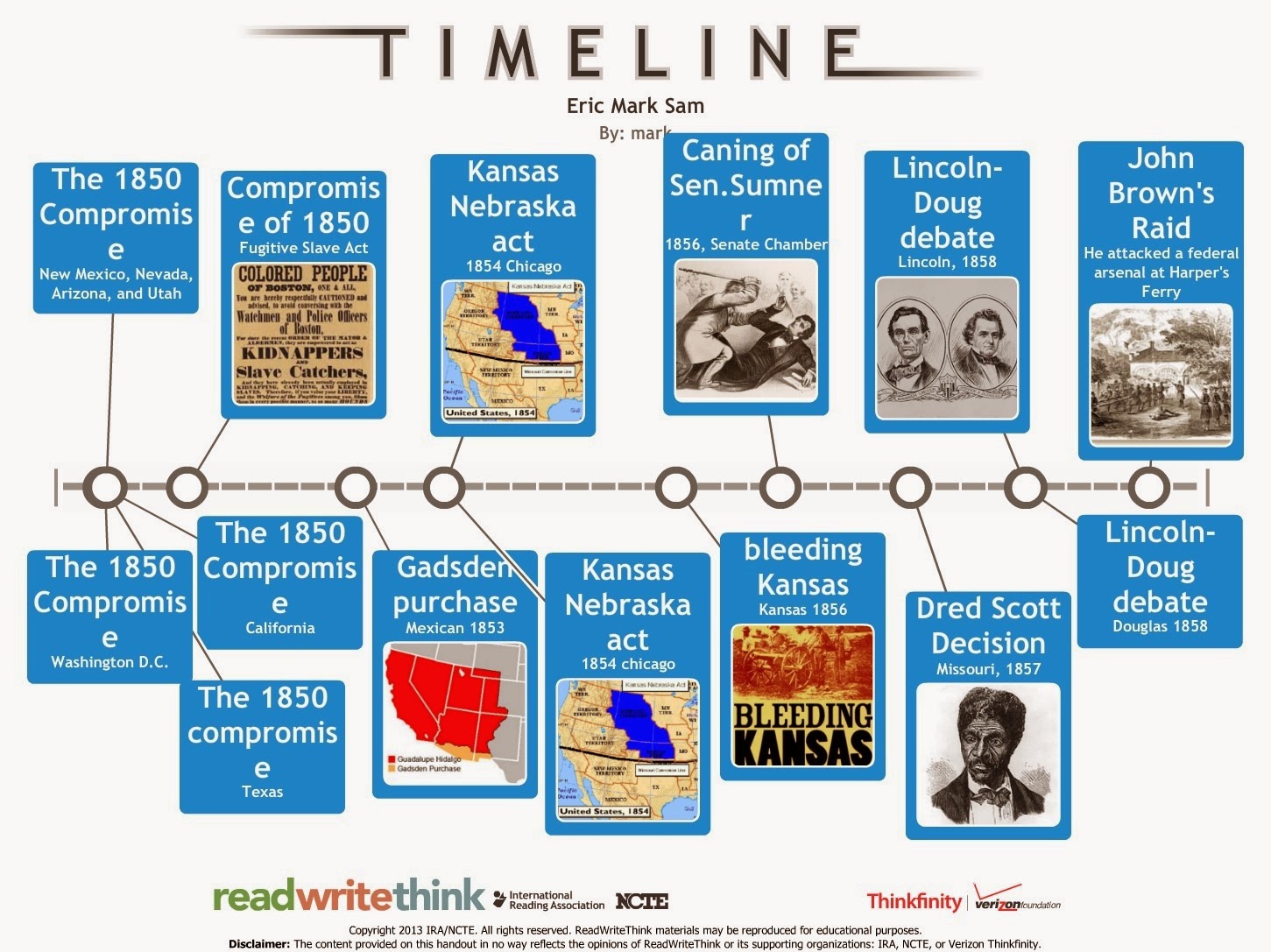
     America in the 1800's was a divided nation even though most people did not realize it. This was because slavery was the elephant in the room in politics. People knew it was a major issue however nobody wanted to directly address it until the problem escalated. In class, we studied all the events leading up to the Civil War which had to do with slavery, and we compiled them into a timeline (below).
     These events show how slavery consumed a majority of decisions which were made by our congress. For example the caning of senator Sumner was anti-slavery because when Preston Brooks hit Sumner with his cane, it showed pro-slavery as violent and unruly, widening the gap in America's politics. On the contrary, an event which favored slavery was Bleeding Kansas. This event refers to the fighting between free soilers, a group who wanted nothing to do with black people, and pro slavery settlers. the two groups fought for control of Kansas, wanting to make it into a free state or slave state respectively. An event which affected both sides of the argument was the famous debate between sen. Lincoln (yes the president) and sen. Douglas. Both political giants faced off and preached their views, Lincoln claiming that the majority shouldn't be able to take away someone's life liberty and pursuit of happiness. Finally, another two-way decision is the Kansas-Nebraska act. This act created the territories of Kansas and Nebraska in which slavery was decided by popular sovereignty in exchange for a northern Trans-Continental railroad.  The benefits for the north was that anti-slave settlers could get out west and settle easier and the benefits for the south were that it abolished the Missouri compromise now making slavery potentially legal in northern states. Overall, slavery was clearly a huge issue in 19th century politics but was not directly discussed in most congress meetings.


timeline
timeline

Tuesday, February 24, 2015

Antebellum Slavery

     During  the later part of the eighteenth century, slavery seemed to be on the decline. The American and French Revolutions gave many slaves an opportunity to escape servitude and become free. Also, revolutionary ideas spread throughout the Caribbean, Spanish America and the United states, convincing many slave owners to let their slaves go. However, during the early nineteenth century, slavery underwent a huge boom in the southern part of the United States and Spanish territories in the New world. The reason for this boom was mostly due to Eli Whitney's latest invention, the Cotton Gin. The Cotton Gin vastly sped up the cotton cleaning process allowing for garments to be made faster. To keep up with the demand of cotton, many more slaves were imported to the United States. To put it in perspective, in 1790, the entire South produced about 1.5 million pounds of cotton and in 1860 the South produced nearly 2.3 billion pounds of cotton. By 1860, slavery had become firmly entrenched in the South due to the increased cotton demand.
 
     By basing slavery on race, the race which is forced into slavery loses all their dignity because they are considered inferior to the race which put them there. For example, prince Abdul Rahman was considered royalty in his community in Africa until he was taken into slavery in Missouri where he was nothing more than slave. Also, His owner cut off his long  hair which was a strong symbol of pride and importance in his culture. Rahman had his dignity stripped away by being put into slavery. This system of race based slavery ignores intelligence thoughts and morality and just categorizes people based on skin color. This shows how flawed and fundamentally wrong slavery is.


Monday, February 2, 2015

Fear of women

     In class, we have been learning about reforms in the 1800's in America. Most recently we learned about the Women's Reform. Our essential questions were:  How did mid ­19th century American society react to women's demands for equality? Does 21st century society still react differently to men and women? To answer these questions we read a couple of different articles and even watched a modern day commercial. Another thing we did was look at this picture to determine if it was an accurate representation of a women's life during the 1800's.
     The first article we read and took notes on was called the Intimately Oppressed by Howard Zinn. With this article we picked out passages and asked questions about them so that our fellow classmates could answer them and further our understanding of the reform. Next, we read The Rights of Women: Laws and Practices which talked about the social restrictions placed on women during the 1800's. Then, we compared those restrictions to the resolutions proposed in the Declaration of Sentiments and Resolutions, a document drawn up by the Seneca Falls convention that detailed the rights that women wanted to have and pointed out how they have been oppressed. Using all this information, we answered the first essential question. Society reacted to women's demands for equality by both accepting it and denying it, some men were afraid that by letting women have rights society would collapse and other people wanted women's rights because they knew it would be beneficial to everyone. To help answer the second essential question, we watched a Filipino Pantene add showing how society views women based on their jobs or actions. The answer we came up with was that people do view women differently but a lot less so than in the 1800's and they are not as public about it. Overall, the women's Reform was very effective in giving women more rights and allowing them to play a bigger part in society.

Sunday, January 11, 2015

Education Reform primary sourceing

HORACE MANN ON EDUCATION AND NATIONAL WELFARE
.... According to the European theory, men are divided into classes,—some to toil and earn, others to seize and enjoy. According to the Massachusetts theory, all are to have an equal chance for earning, and equal security in the enjoyment of what they earn. The latter tends to equality of condition; the former, to the grossest inequalities. Tried by any Christian standard of morals, or even by any of the better sort of heathen standards, can any one hesitate, for a moment, in declaring which of the two will produce the greater amount of human welfare, and which, therefore, is the more conformable to the divine will? The European theory is blind to what constitutes the highest glory as well as the highest duty of a State....
. . .

Education then, beyond all other devices of human origin, is a great equalizer of the conditions of men,—the balance wheel of the social machinery. I do not here mean that it so elevates the moral nature as to make men disdain and abhor the oppression of their fellow men. This idea pertains to another of its attributes. But I mean that it gives each man the independence and the means by which he can resist the selfishness of other men. It does better than to disarm the poor of their hostility toward the rich: it prevents being poor. Agrarianism is the revenge of poverty against wealth. The wanton destruction of the property of others -- the burning of hay-ricks, and corn-ricks, the demolition of machinery because it supersedes hand-labor, the sprinkling of vitriol on rich dresses -- is only agrarianism run mad. Education prevents both the revenge and the madness. On the other hand, a fellow-feeling for one's class or caste is the common instinct of hearts not wholly sunk in selfish regard for a person or for a family. The spread of education, by enlarging the cultivated class or caste, will open a wider area over which the social feelings will expand; and, if this education should be universal and complete, it would do more than all things else to obliterate factitious distinctions in society...

Source: Horace Mann, twelfth annual report to Massachusetts Board of Education.

      Horace Mann, known as the father of American education, wrote this document while he was Secretary of Massachusetts State Board of Education addressing the board. He wrote it just as an annual report to reflect on the state of the schools in Massachusetts and inform the other board members. Written by the leader of the education reform, this document can be trusted and gives us a good picture of Horace's job. At the time when this was produced, the education reform was beginning with Horace Mann at the forefront, trying to create the public school system we have today. The document shows us that Horace had a position of power in the board and was trying to influence other members. Also, we see that the European way was to have people divide into a class system. This document is just the tip f the iceberg when it comes to education reform, there are many more aspects of the reform that are not covered by the document. In writing this report, Horace is trying to convince the school board that education must be given fairly to each student and everyone must have the same opportunities in the public school system. Mann says "all are to have an equal chance for earning, and equal security in the enjoyment of what they earn." This means that everyone is equal in their education. Horace speaks very eloquently and his words are very powerful which illustrates how much he cares about creating equality in education. Although the education reform was much more than this, the document gives great insight into Horace's ideals.

Monday, December 15, 2014

Andrew Jackson

To further our studies about Democracy in America, we learned about Andrew Jackson, one of the first presidents to lead the new Democratic nation. There are many conflicting views on whether or not he was a good president, and our essential question is "Is Andrew Jackson's long-standing reputation as "the people's president" deserved?" Personally, I do not think Andrew Jackson should be remembered as the people's president because he made some really bad decisions. The worst decision he made was to force the Native Americans to abide by the United States laws and not even giving the basic rights as U.S. citizens causing them to lose their land and go on a forced march to relocate called "the Trail of Tears". By doing this, Jackson violated the definition of democracy,  a form of government in which eligible citizens may participate equally – either directly by voting for the passing/ rejecting of laws. To learn in-depth about Andrew Jackson, we looked at three of his defining points as a president, the Bank War, the Spoils System, and the Indian Removal. We split into groups to analyse the primary sources about each topic and then each group made a presentation about a particular aspect. My group performed a skit about the Indian Removal and unfortunately I don't have the script. Overall, it was fun to use the knowledge we learned from the documents and turn it into our own presentations and everyone learned a lot.

Andrew Jackson

Wednesday, December 10, 2014

L.A. Revolutions

         Transitioning from The Haitian and the Revolutions of 1830/1848, we learned about the Latin American Revolutions. Our essential question for the unit was, why is it essential to acknowledge human value regardless of race? How are the events in the Latin American Revolutions evidence of this social
imperative? This is important because the Latin American Revolutions were based completely off of race. For our lesson, our class split into different groups and each analysed one of the various Revolutions. Then, each group created a timeline of events for their particular revolution and shared it with the class so we could figure out the essential question.

          The group I was in studied the Mexican revolution. We came up with the timeline shown below:

1. Early 1800s: Napoleons occupation of Spain led to the outbreak of revolts across Spanish America.

2. Miguel hidalgo y costilla launched the Mexican rebellion with the "cry of Delores"

3. He was defeated at Calderon and fled north but was captured and defeated.

4. 1820 liberals took power of Spain and the new government promised reforms to appease the Mexican revolutionaries.

5. In 1821, Agustin de iturbide negotiated that Mexico would be an independent constitutional monarchy

6. August 24, 1821 Spanish viceroy Juan O'Donojú signed treaty of Córdoba which makes Mexico an independent constitutional monarchy.

7. 1822 iturbide becomes emperor of Mexico

8. 1823 Santa Anna and Guadalupe Victoria set up a republic, with Guadalupe Victoria as first president.

This shows how the Mexican revolution changed the government from a monarchy to a republic and it eliminated the racial advantages of the Spanish-born peninsulaires. By comparing all of the revolutions, we discovered that they were against the establish monarchies and they all fought to instate a new government system. They wanted to change the government so that the various races could be more equal. Some differences we noticed were that the Brazilian Revolution was mostly peaceful, the Gran Colombian was very violent and the Mexican was between the two. Also, their social climate made them act out in different ways. Race played its part in all three revolutions by the following: 

Mexico: the mestizos and Indians revolted against the Spanish rule and wanted redistribution of land and race equality.

Brazil: the ruler after independence would only let Portugal born people in his office and became very unpopular. Everyone but the peninsulaires felt wronged and revolted against the corrupt system. 

Gran Columbia: the South Americans didn't want to be opposed by the Spanish. Bolivar wanted to get rid of Spanish rule and the race system.

       Similar to the Spanish American societies, race is still an issue today. A clear example of this is in the Ferguson Missouri case where people are violently protesting that the victim was shot because he was black and the white police officer was not punished. I find it sad that race is still an issue in our country because it has been a very long time since slavery and we are all human beings. I think we need to treat people the same regardless of race, much like the ideals of the Latin American Revolutions.

Wednesday, December 3, 2014

Democracy in america

To demonstrate how democratic America was in the early 1800s, our group created a poster. We showed how the three source documents supported our argument that the united states slowly became more democratic over the years.


Saturday, November 22, 2014

Toussaint Louverture DBQ

Mark Porter
11/17/14
How should Toussaint Louverture be remembered
Good leaders have traits that make them great.  Looking at great leaders during history, we can determine these qualities.  Abraham Lincoln is one of the best examples of a good leader, his three most important qualities were toughness, moral leadership and honesty. Lincoln displayed these traits by granting slaves freedom in the U.S. and maintaining the country during a bloody civil war. Toussaint Louverture, leader of the Haitian Revolution, possessed these qualities and used them in similar situations as Lincoln which is why he is considered a great leader. He should be remembered as a liberator of slaves, however he was a great military commander and ruler too.
Toussaint committed most of his free life to liberating the slaves of the French colony Saint Domingue. He knew what it was like being a slave having grown up in servitude and he did not want any of his country-men to suffer that fate. When news of the french revolution reached the island and fighting broke out, Toussaint worked as a doctor to the troops (Doc. A) and convinced slaves to fight for their freedom. By 1793, he led an army of 4000 slaves. Then, when the new revolutionary French government abolished slavery, Toussaint ordered his troops to stop fighting and support the french, showing his dedication to eradicate slavery. (Doc. A) After that, in 1797, Toussaint wrote a letter to the French Directory (the government which replaced the one that abolished slavery) saying that it was impossible for saint domingue to institute slavery again. Toussaint backs up his argument by saying “They bore their chains when they knew no condition of life better than slavery.” (Doc. B) meaning that the slaves were only slaves because they didn't know what it was like to be free and they would rather fight than go back into slavery. Finally, Title II, Article 3 of the Saint Domingue Constitution Toussaint wrote, there cannot be be slavery and all men are born, live and die free and French. (Doc. C) Toussaint was dedicated to freeing his country from slavery, putting that before all of his other goals.
Before he was a liberator of slaves, Toussaint was a strong military commander who led the revolution to free his people to claim Saint Domingue. His best strengths as a leader were his ability to recruit people to join his cause, make tough but necessary decisions and maintain an organized army. Toussaint was a natural born leader, earning his freedom from slavery, owning a plantation himself and later gathering men to join in the revolution. An example of a hard decision he made was killing one of his high ranking commanders, Hyacinthe Moyse. Moyse oversaw the Northern Department of Saint Domingue and did not like Toussaint’s labour laws, nor his friendliness with white planters. (Doc. E) This dislike grew to a state of hatred and Moyse along with many of his men went on a rampage, killing any white man they came across in the Northern department. To mend this, Toussaint stopped the massacre, made Moyse’s men kill themselves and had Moyse put to death. This sounds cruel however it was necessary to ensure that people remained loyal to Toussaint and that peace was kept. Finally, Toussaint kept his army ready for anything the European oppressors threw at them by teaching them  European style and guerilla style fighting. (Doc. A) Toussaint was a great military commander which helped him to liberate the slaves of Saint Domingue.
As ruler of Saint Domingue, Toussaint worked to ensure the prosperity and success of the country. To maintain order and keep up the production of coffee and sugar flowing out of Saint Domingue without slave labour, he helped to create the Saint Domingue constitution in July, 1801. The constitution abolished slavery and put in a new system that stated each plantation will represent a family and the owner of the land was the father. Also, the father must share the revenue with his family to ensure everyone is treated equally. (Doc. C) Then just 4 months after the constitution was put into action, Toussaint issued a new proclamation that contained rules about plantation farming. The basis for this proclamation was to enforce and make clear the laws that were detailed by the constitution. For example,one part of the proclamation is: “Vagabond Cultivators arrested...shall be taken to the commander of the quarter, who will have them sent to the gendarmerie [local police] on their plantation.” (Doc. D) This rule backed up the family based model of the plantations, also making it clear that it was not acceptable to wander to different plantations. By putting the proclamation into effect, Toussaint did become less popular, however, he did it to maintain order and function as ruler of Saint Domingue.
Although Toussaint was a formidable military commander and a great ruler, he should be remembered for his greatest work, liberating the slaves of Saint Domingue. He used the power and influence gained by being a leader to accomplish this. Also, all of his actions were done for the sake of ending slavery. Great leaders are remembered for their most important contributions to society, so there is no doubt Toussaint Louverture should be remembered for liberating the slaves of Saint Domingue.

Monday, November 10, 2014

Revolutions of 1830 an 1848

Recently in class, we learned about the revolutions of 1830 and 1848. The overarching question we were trying to answer was, "were the revolutions of 1830 and 1848 really failures as many historians have concluded?" To gather the information we did a lot of things. First, we looked at a map of the revolutions to see how they developed. Next, we created a scale to judge what is considered a success or failure and in between. Our scale looked like this: failure/revolution was crushed and many died, partial failure/revolution failed however some new ideas took root, neutral/revolution didn't fail or succeed, partial success/many of the revolutions goals are met but there are a lot that weren't, success/all of the revolution's goals are met and the government is changed. Then, we observed the quote by Klemens Von Metternich "When France sneezes, Europe catches a cold." We concluded that this quote meant that the ideas that come out of France and specifically the French Revolution spread across Europe and create revolutions. After that, we analyzed key documents to find out everything about our assigned revolution. then we fit the primary sources into three different categories based on what they are about: Goals, opponents, outcome. Finally, we placed our revolution on the scale of success we made earlier to answer the essential question.

The revolution my group was assigned is the French Revolution of 1848. Obviously the setting was France, 1848. The goal of the revolution was to end the monarchy and stop Louis Philippe's corrupt government. The lower class was fighting against the upper and middle classes as well as Louis Philipe. The rebels wanted to end the recession caused by Louis Philipe and put in place a republic. They eventually got rid of Louis Philipe and voted in Louis Napoleon, Napoleon Bonaparte's nephew into power. This success for the revolution was short-lived, in 1852, Louis Napoleon took absolute control over France and became an emperor. During this time of turmoil, many primary sources were formed. From the documents of the Revolution of 1848 in France, "Citizens:royalty under whatever form , is abolished; no more legitism, no more Bonapartism, no regency." This quote describes the goals of the revolution saying how they wanted a republic and to get rid of the old ways. Also, another primary source, the Proclamation of 14 January 1852, is Louis Napoleon describing how he made France great again. To teach the rest of the class about the Revolution of 1848, we created a survey monkey. Our survey monkey was a test of all aspects of the revolution and our class did well on it.

 
A screenshot of our results, most people got this question right.
The Revolutions of 1830 and 1848 were as much failures as historians say they are. first, in 1848, the Frankfurt Assembly was brought together to make a constitution for the German states. They could not make one and the assembly was dissolved under threat of the Austrian military. Hundreds were killed and many imprisoned and thousands fled their homes to get away from Germany. Next in Hungary, 1848, the revolution got rid of their emperor Metternich and caused the Austrian government to make some reforms, but, no long after, the resistance was crushed and thousands of revolutionaries were killed, imprisoned or forced to leave. Finally, the Decembrist revolt of 1825 was a disaster. When the people tried to rise up against Tsar Nicholas, he fired upon them and beat his own people to the ground. These three revolutions were horrible failures. I think the answer to the essential question is accurate however, there was some success in the revolutions, they made people think differently than ever before and stood up for their beliefs.


Monday, October 27, 2014

Congress of Vienna

To start off this unit we paired up to read and explain the background essay on the Congress of Vienna. After, we watched a video about Napoleon and Klemens Von Metternich. The video described Napoleon's reaction to Metternich's changes and the Congress of Vienna. Also, we watched a clip that showed how the map of Europe changed from the changes imposed by the Congress of Vienna. Our essential question, What should people in power do when their power is threatened, relates to this because the members of the Congress of Vienna needed to protect their power from angry revolutionists. There are four principles which the European powers used to protect their power, Balance of Power, Principle of Legitimacy, Holy Alliance and Principle of Intervention.

Tzar Alexander spearheaded the idea of making a Holy Alliance within The Congress of Vienna. A Holy Alliance prevents revolt by saying that Monarchs had the divine right to rule and any revolution was treason against God. This principle worked fairly well because it was going back to the old ways before Napoleon when things were mostly stable. Also, the people in power had the support of the church making it not such a good idea to revolt. Overall, The Congress of Vienna mostly undid the physical aspects of Napoleon's conquest however, Napoleonic ideas spread throughout Europe, sparking some revolutions that could not be contained. One of these revolutions even pushed Metternich out of power. Also, there was no fighting between the five nations of the Congress of Vienna up to 1853.

I think the members of The Congress of Vienna could have made better choices. They mostly thought about themselves and expanding their already large countries. Instead, they could have accommodated the smaller countries and listened to their people. They could have given the people more say in the governments which would have been more effective at stopping revolts. The people in power should have given up some of their power so that everyone was satisfied.

Wednesday, October 15, 2014

Napoleon's Influence


Many historians agree that napoleon was among the greatest rulers in Europe and perhaps of all time. To find out his impact on the social, economic and political systems of Europe, I read the accounts of Madame de Stael and Michel Ney and an article called The Lost Voices of Napoleonic Historians. Madame de Stael did not think napoleon was all that great while Michel Ney thought he was a fantastic general and a great ruler. The Lost Voices of Napoleonic Historians tells the story of all the men and women who have written books about Napoleon, some of which were negative and many which were positive.

Napoleon had a huge impact on Europe as a whole. He conquered many countries and one time controlled nearly 75% of Europe. Political speaking, napoleon had a positive impact for the general people, and a negative impact for the royalty. He established a meritocracy, a system where your position in society is based on your skills and abilities, not because you were royal. Also, when he conquered an area of land, he would let the current ruler continue to govern, something that was not normally done. Napoleon was a master at creating tending to the needs of the economy. Napoleon added massive improvements to the infrastructure of Europe by creating public works projects such as building roads and bridges. As well as helping with public works, Napoleon encouraged the arts and industrialized parts of Europe. Finally, Napoleon helped with the social aspects of Europe. He increased the availability of education and allowed his citizens to have more property rights. After invading Egypt, Napoleon reorganized their government and established the University of Egypt.

In my opinion, napoleon was a huge positive influence to all of Europe. His skills as a military commander were unparalleled and he was an outstanding leader. He cared about the future of our world by emphasizing education and optimizing the outdated governments of Europe. This being said, some of what Napoleon did was wrong, such as killing thousands of people to conquer their country. Overall, Napoleon was a great leader and brought about many necessary changes to Europe.

Thursday, October 9, 2014

capitalism, socialism, communism oh my!

To demonstrate Marxism we played a game. In the game, Mrs. G distributed Hersey kisses to all of us to represent wealth Most kids got 3 but a few got more than that. Then, we played rock, paper, scissors, shoot with each other and the loser had to give one piece of candy to the winner. After we totaled our candy, Mrs. G took it back and redistributed it, showing how capitalism eventually leads to communism. This activity was both fun and frustrating, we got to eat candy but it was annoying that the government could just take all of your hard earned wealth.

Karl Marx and Adam Smith both had very different ideas for a government system. Marx believed that everybody should have equal wealth controlled by the government, a classless society. While Smith believed that there should  free trade among the people, not controlled by the government. Marx's system helps the poor because they have just as much as everyone else. Smith's idea benefits the poor because competition between traders creates low enough prices for everyone to afford.

In my opinion, Smith's theory is better than Marx's. I like the idea of having a loose government to step in when things go badly, not an over controlling or no government. This being said, I think the best system is to have a combination of the two. Let people buy, sell and trade what they want, but have them pay taxes in return for things like healthcare, very much like our system in the U.S.

Monday, October 6, 2014

Working Conditions in the Mills, U.S. vs. England

The working conditions in both England and Lowell were bad. However, it was worse in England due to many reasons. First, England came into the Industrial Revolution before Lowell thus having more time for the factories to start heading into squalor. Another reason is that the men who created the Lowell mills observed the English mills and tried to correct their mistakes. The Lowell experiment as it was called did not succeed as well as the creators had hoped, the workers were still treated badly and received low wages. Also, the Lowell mills had boarding houses nearby for the workers to live in, while in England most of the workers were living in squalor in the streets. In England, the workers had to wake up earlier, work later and didn't have designated eating times, as opposed to the breakfast lunch and dinner breaks the workers in the Lowell mills got. Finally, when the Lowell mill worker's wages got cut, they protested against it and it eventually paid off. To find out more about the Lowell Mills you can check it out here

Monday, September 29, 2014

MOSI Google hangout

    We did a very cool and fun activity in history class. We did a Google hangout with a couple of guys from the MOSI museum in Manchester England. This was really incredible because we were talking to people hundreds of miles away from us and we were learning at the same time. Before we Hung out with Jamie and his coworkers, we had to prepare. To do this we checked out MOSI's website to get an idea of what they had at the museum. Also, to prepare, we watched a video where our explainer Jamie showed us some of the machines and explained them. Along with that, we used keywords that we discovered from the site to find out more info on some of the machines and come up with educated questions for Jamie.

    The Hangout ended up being a great success, I learned a lot. in particular, I discovered that the textile making process is somewhat long, dangerous and complex. there are many different machines involved in this process such as the Draw frame , a shuttle loom and a speed frame. Most of the machines worked at high speeds and had many parts, thus making them dangerous to be around. The dangers of the machines included deafness, oil that caused cancer, hair getting caught in the machines and disease could spread quickly. Although these machines were so dangerous, they did increase the production speed of textile production magnificently. The workforce in the factories was almost completely girls raised on rural farms that were looking to support their families or change their lifestyle. Because all the girls moved into the big cities, the farms suffered and many died out, not being able to compete with the mills or the large, company owned farms. There were major pros and cons the mills had and it was very interesting to learn all about them and the infrastructure of the mills from Jamie.

This is Jamie showing us the Shuttle Loom
I thought this activity was fun and engaging while still being school related. It did not feel like I was learning, more like I was having a conversation with an expert. I find it incredible that we are able to talk to these people from across an entire ocean. I would really like to do this type of thing again for a different topic, it is a very good way to learn information. I had a great time with this Google hangout, and it would be great to do another.